top of page

Our Framework: A Foundation Built on Real-World Systems:

Stories of Business was not built as a theory.
It is the result of analysing over 1,000 real-world systems — across industries, countries, and contexts — from global supply chains and infrastructure to markets, behaviour, and everyday business environments.

Across those observations, one pattern emerged consistently:
systems are rarely understood in the way they actually operate.
They are designed, funded, and documented — but not always translated into real-world understanding.
The Stories of Business System Lens exists to close that gap.

What People See Is Not the System
At its core, the framework is built on a simple idea:
what people see is not the system — it is only the entry point.
A product, a project, a policy, or a place is rarely the system itself. It is the visible surface of a deeper structure shaped by incentives, dependencies, behaviours, and constraints.
Understanding that structure is what determines whether outcomes align with intent.

How the Framework Works
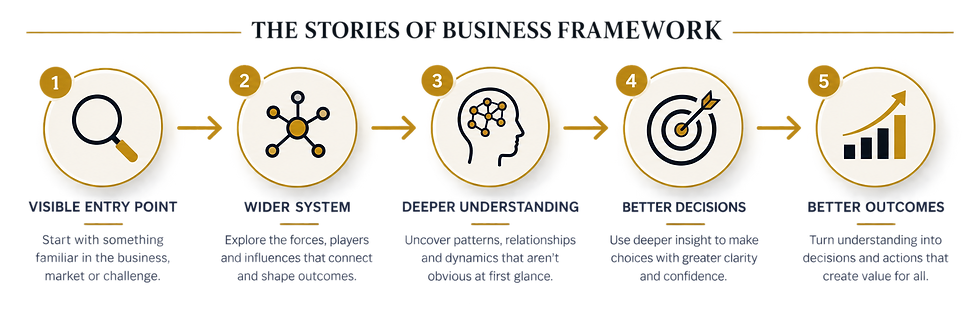
The Stories of Business System Lens moves through five connected layers.
Each layer reveals a different dimension of how a system actually behaves.

1. The Visible Entry Point
This is what people believe they are looking at.
A product on a shelf.
A development programme.
A service, a market, or an intervention.
It is the most accessible part of the system — and often the most misleading.

2. The Underlying System
Beneath the surface sits a structure of flows and dependencies.
Supply chains, infrastructure, institutions, and relationships all combine to create what appears at the entry point.
This layer reveals that what looks simple is often deeply interconnected.

3. The Incentive Reality
Systems are not driven by intention — they are driven by incentives.
Every actor within a system behaves according to pressures, rewards, and constraints.
Profit, efficiency, access, policy, and survival all shape how the system actually functions.

4. The Real-World Translation
This is where systems meet reality.
Design meets behaviour.
Structure meets context.
Culture, local constraints, infrastructure gaps, and human decision-making all influence how a system operates in practice.
This is where theory begins to break.

5. The Outcome Gap
Every system is designed to produce an outcome.
But what it delivers in reality is often different.
The gap between intended outcomes and actual results is where the most important insights sit — and where the greatest risks and opportunities exist.

Bringing the Framework to Life: A Banana on a Supermarket Shelf
To understand how the framework works in practice, consider something simple:
a banana on a supermarket shelf in the UK or the United States.
At first glance, it appears to be one of the most ordinary items in the world — low-cost, widely available, and easily replaceable.
It seems straightforward.
But that banana is not the system.
It is only the entry point.

The Visible Entry Point
A consumer sees a banana — priced, available, ready to purchase.
The interaction appears simple: choice, price, purchase.

The Underlying System
Behind that banana sits a global network.
It may have been grown in Ecuador, Colombia, or Costa Rica. It moves through producers, exporters, shipping routes, port infrastructure, distribution centres, and retail procurement systems.
Temperature-controlled logistics and global trade routes sit beneath what appears to be a local product.
What looks local is, in reality, global.

The Incentive Reality
Each participant in that system is driven by different incentives.
Farmers aim to maximise yield under pricing pressure. Exporters prioritise volume and contractual reliability. Shipping companies optimise efficiency and cost. Retailers focus on margin, availability, and consistency. Consumers respond to price, convenience, and perceived quality.
These incentives do not always align — and that misalignment shapes outcomes.

The Real-World Translation
When the system meets reality, friction appears.
Bananas that do not meet cosmetic standards are rejected. Weather conditions affect supply. Infrastructure limitations influence distribution. Labour conditions vary. Consumer expectations drive waste.
The system behaves differently in practice than it does on paper.

The Outcome Gap
The intended outcome is simple:
reliable, affordable access to fresh produce at scale.
The actual outcome often includes:
waste, pricing pressure on producers, supply chain fragility, and uneven distribution of value.

What This Reveals
The banana is not the system.
It is the surface of a deeper structure — one shaped by incentives, dependencies, and real-world constraints.
Understanding that structure changes how the system is seen — and how it can be improved.
From Observation to Application
The Stories of Business System Lens  is built to make these dynamics visible.
Not by simplifying them, but by making them understandable in practice.

How the Framework Is Used
In applied settings, the framework is used to:

  • clarify how complex systems operate beyond formal documentation

  • improve stakeholder understanding and engagement

  • identify where incentives and outcomes are misaligned

  • strengthen the likelihood that programmes translate effectively into real-world impact
     

Beyond Communication
This work moves beyond traditional communication.
It is not about producing content around a system.
It is about:
revealing how that system actually behaves — and what determines whether it succeeds or fails.

The Next Phase
As Stories of Business evolves, this framework now sits at the centre of institutional partnerships.
Where organisations are working across complex systems — whether in development, policy, infrastructure, or markets — the challenge is not only to design and fund effectively, but to ensure those systems are understood in a way that supports real-world outcomes.
The Stories of Business System Lens provides that layer.

bottom of page